



E-world 2026: When Complexity Becomes the Real Conversation
Germany remains Europe’s largest and most competitive retail energy market: more than 50 million metering points, over a thousand electricity suppliers, and one of the highest household switching rates on the continent. For years, competition was driven largely by price. That lever is now blunt. Structural costs keep tariffs high; wholesale electricity market volatility driven by renewable intermittency and geopolitical exposure adds pressure , and customers are more willing than ever to switch.
Regulatory super-cycle
If we take a step back, it is worth acknowledging the deeper issue many utilities voiced this week: the transition is forcing regulatory change faster than the market can realistically absorb.
§14a is already creating operational headaches. Smart meter regulation remains unresolved in practice, with uncertainty around rollout pace, cost, and the reality of serving millions of customers who may remain on legacy meters well into the next decade. Only around 3% of meters are currently fully smart, yet every supplier must be ready for dynamic pricing and flexibility services. Retailers must innovate for the future while still serving a massive legacy base.
At the same time, new models are beginning to emerge, particularly in the B2B space. Load-curve based contracting (RLM) is becoming more common. Mieterstrom continues to attract interest, although its billing and settlement path remains far from straightforward.
What is striking is that these pressures are challenging Stadtwerke and private suppliers alike and there is still doubt about the best way forward.
Several utilities spoke openly about unfulfilled promises in the market. In some cases, this has triggered a retreat back toward incumbent players, simply because they feel safer. Yet there is no certainty that the latest “cloud versions” of legacy systems are actually designed for the operational complexity now arriving. And even if the technology were ready, there is a shortage of specialists across the ecosystem to deliver the volume of transformation projects Germany will require. The market feels torn between acting fast and waiting for clarity.
Meanwhile, outside of Germany, many suppliers are accelerating, making decisions, deploying new models, and moving ahead.
Germany is at a crossroads: the ambition is there, but the execution path is still being negotiated.
B2B Energy: Can Complexity Become a Competitive Edge?
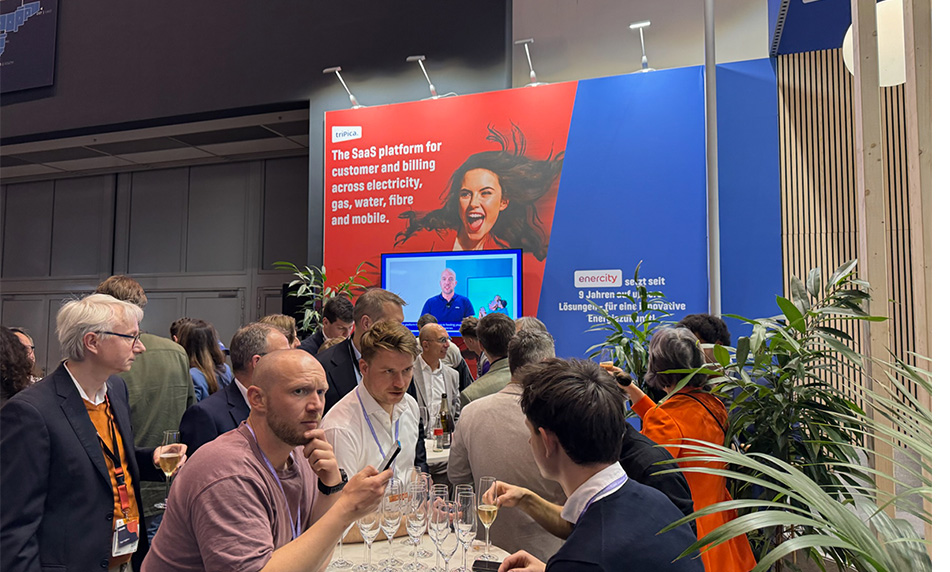
Germany’s B2B energy market has shown notable evolution. Electricity and gas contracts for commercial and industrial customers are increasingly structured around indexed pricing and flexibility layers . Value is no longer created by selling volume, but by managing volatility and transparency. Yet many organisations still rely on spreadsheets layered on top of legacy billing engines. That tension is becoming visible. triPica is on a mission to enable energy retailers to serve their commercial and industrial (B2B) customers with ease. It is purpose-built for the full spectrum of utility B2B and we demonstrated live at e-World how our customers Primeo Energie and Evole are already using triPica to manage their B2B customers at scale and win.
Energy Flexibility Requires IT Flexibility
What triPica brings to the table is pragmatism. Utilities know change is unavoidable. The question is not whether to modernise, but how to do so without jeopardising reliability, compliance or trust.
At the same time, Germany’s energy system is becoming greener. Renewables already represent roughly 60% of electricity supply and continue to rise . Will the flexibility become a business model, or just a grid necessity? If yes,flexibility on the energy side will demand flexibility on the IT side.
Forward-looking utilities should look for adaptable IT platforms, that allow them to move faster without losing control. Why be overwhelmed by complexity when you can monetise it instead?